
Why Choosing the Right CRM Expert Agency Matters
CRM implementation is much more than installing software and creating user accounts. A CRM becomes an important part of your company’s daily operations, including lead management, sales activities, customer communication, marketing campaigns, customer support, reporting, and business automation.
A poorly planned CRM implementation can create more problems than it solves. Employees may find the system difficult to use, important data may be duplicated, workflows may become unnecessarily complicated, and integrations may fail to provide the expected results.
Common problems caused by poor CRM implementation include:
- Low employee adoption
- Duplicate, incomplete, or inaccurate customer data
- Inefficient sales and customer service workflows
- Poor integration between business systems
- Excessive manual data entry
- Higher operational costs
- Limited reporting and business visibility
- Difficulty scaling the CRM as the company grows
- Unnecessary customization and maintenance costs
On the other hand, the right CRM consulting agency can analyze your existing processes and design a CRM environment that supports your business objectives.
For example, a sales team may currently manage leads through spreadsheets, emails, and messaging applications. A CRM agency can introduce automated lead assignment, follow-up reminders, sales pipelines, notifications, lead scoring, and management reports. This can reduce manual work while giving managers better visibility into the sales process.
Things to Consider Before Hiring a CRM Agency
“`
1. Experience With Your Required CRM Platform
The first factor to evaluate is the agency’s expertise with the CRM platform you currently use or plan to implement. Different CRM platforms have different architectures, customization options, APIs, automation tools, reporting capabilities, and integration methods.
An agency may be highly experienced with one CRM platform but have limited knowledge of another. Therefore, make sure the agency has hands-on experience with the exact platform and version relevant to your project.
Ask potential agencies:
- How many projects have you completed on this CRM?
- Do you work with the current version of the platform?
- Can you handle both configuration and custom development?
- Do you have experience with APIs and third-party integrations?
- Can you provide examples of similar projects?
- Do your developers and consultants have relevant certifications?
Look for a team of proven CRM experts rather than an agency that simply provides basic CRM setup services.
2. Industry-Specific Experience
CRM requirements can vary significantly between industries. A CRM designed for an eCommerce business may look very different from one used by a real estate company, financial organization, SaaS business, healthcare provider, or B2B sales organization.
For example, an eCommerce company may need integrations with its website, payment systems, marketing platforms, order management tools, and customer support applications. A B2B company may require sophisticated lead qualification, account management, sales pipelines, recurring follow-ups, and detailed reporting.
An agency with relevant industry experience may already understand common workflows and challenges. However, industry experience should not be the only deciding factor. The agency must still take the time to understand your unique processes instead of simply applying a standard CRM template.
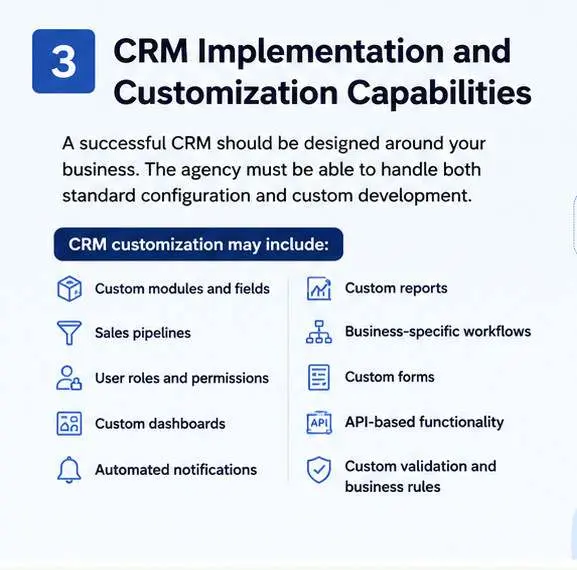
3. CRM Implementation and Customization Capabilities
A successful CRM implementation should be designed around your business rather than forcing your business to work around the software.
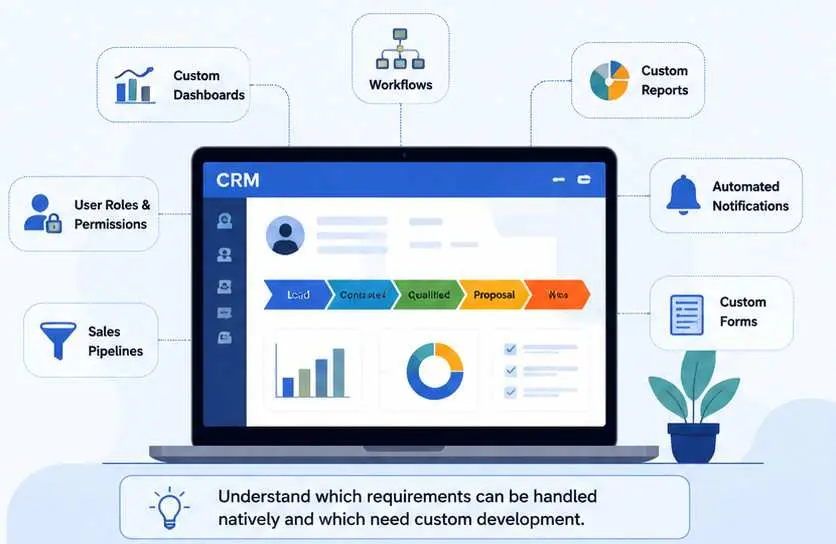
Before hiring a CRM implementation agency, determine whether it can handle both standard configuration and custom development when required.
CRM customization may include:
- Custom modules and fields
- Sales pipelines
- User roles and permissions
- Custom dashboards
- Automated notifications
- Custom reports
- Business-specific workflows
- Custom forms
- API-based functionality
- Custom validation and business rules
Ask the agency to clearly explain which requirements can be handled using native CRM functionality and which ones require custom development. This helps control costs and prevents unnecessary customization.
4. Integration With Existing Business Tools
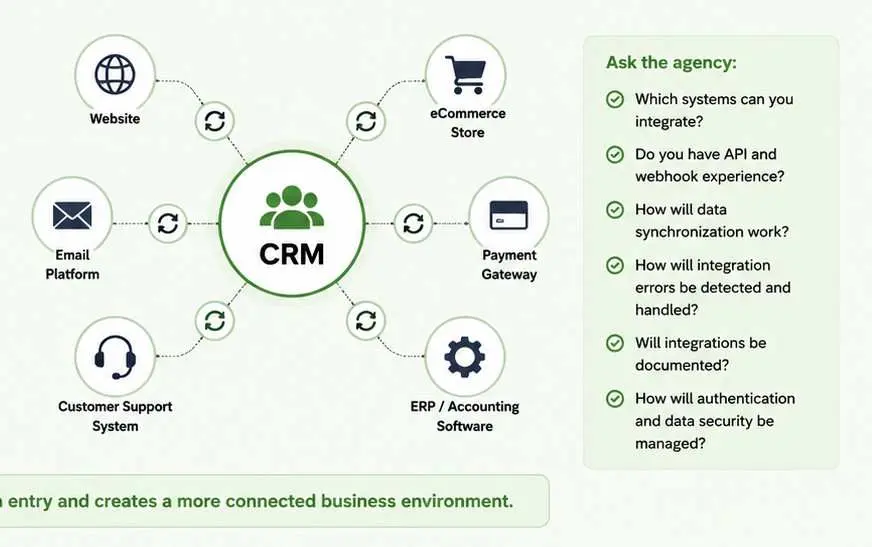
Most businesses already use several applications. Your CRM may need to communicate with your website, ERP, accounting software, email platform, marketing tools, customer support system, eCommerce store, payment gateway, or other internal applications.
A capable CRM development agency should understand how to connect these systems securely and reliably.
For example, when a customer submits a form on your website, the information could automatically create a lead in the CRM. When the lead becomes a customer, relevant information could then be synchronized with another business system.
Ask the agency:
- Which systems can you integrate?
- Do you have API and webhook development experience?
- How will data synchronization work?
- How will integration errors be detected and handled?
- Will integrations be documented?
- How will authentication and data security be managed?
Effective integration eliminates repetitive data entry and creates a more connected business environment.
5. CRM Automation and Workflow Expertise
One of the biggest advantages of CRM technology is automation. A good CRM agency should be able to identify repetitive tasks and determine which processes can be automated without making your business processes unnecessarily complicated.
Common CRM automation examples include:
- Automatic lead assignment
- Follow-up reminders
- Email notifications
- Lead scoring
- Automatic task creation
- Customer onboarding
- Sales pipeline updates
- Escalation alerts
- Marketing triggers
- Renewal reminders
- Internal approval workflows
For example, when a new lead enters the CRM, an automated workflow could assign it to the appropriate salesperson, create a follow-up task, send an acknowledgement email, and notify the sales manager if the lead is not contacted within a defined period.
The goal is not to automate everything. The goal is to automate repetitive processes while keeping important human interactions where they provide value.
6. Data Migration, Security, and Data Quality
Data migration is one of the most important stages of CRM implementation. If your existing customer information is stored in spreadsheets, another CRM, databases, or multiple systems, the agency should have a structured migration strategy.
The agency should explain how it will handle:
- Data cleaning
- Duplicate records
- Field mapping
- Data validation
- Data backup
- Migration testing
- User permissions
- Sensitive information
- Post-migration verification
Moving poor-quality data into a new CRM does not solve the underlying problem. A professional agency should identify duplicate, outdated, incomplete, or inconsistent records before migration.
Security should also be considered from the beginning. Access controls, authentication, permissions, backups, secure integrations, audit trails, and appropriate data-handling practices should be included in the implementation plan.
7. Scalability and Future Growth
Your CRM should support your business not only today but also as your organization grows. A solution that works for ten users may require significant changes when your company reaches hundreds of users or expands into new markets.
Consider whether the agency can support future requirements such as:
- More users and departments
- Additional sales pipelines
- New integrations
- Advanced automation
- Increased customer data
- New geographic markets
- Advanced analytics and reporting
- Additional customer service processes
Ask potential agencies how they design CRM solutions for future growth. A good CRM partner should think beyond the initial launch.
8. Communication and Project Management
Even a technically strong agency can struggle if communication is poor. Before starting the project, make sure both sides agree on how requirements, milestones, changes, testing, and approvals will be managed.
Understand:
- Who will be your primary point of contact?
- How frequently will you receive project updates?
- Which communication channels will be used?
- How will requirements and changes be documented?
- How will project milestones be tracked?
- How will delays or technical issues be communicated?
- Who will approve completed project phases?
A clear project management process reduces misunderstandings and keeps the implementation aligned with your expectations.
9. Portfolio, Case Studies, and Client Reviews
Never select a CRM agency based only on claims made on its website. Review its portfolio, case studies, client testimonials, online reviews, certifications, years of experience, and previous project types.
Case studies are especially useful because they demonstrate how an agency approached an actual business problem, what technology it used, and what solution it delivered.
Whenever possible, ask for examples of projects similar to yours in terms of CRM platform, business size, integrations, number of users, or overall complexity.
10. Pricing, Contracts, and Transparency
CRM projects can be priced in several ways, including fixed-price projects, hourly billing, monthly retainers, or milestone-based contracts. Do not compare agencies based only on the lowest quote.
Instead, compare:
- Scope of work
- Deliverables
- Estimated timeline
- Development hours
- Included revisions
- Integration costs
- Data migration costs
- Training
- Support
- Maintenance
- Additional development charges
Ask the agency to clearly explain what is included in the quotation and what would be considered additional work. A low initial price can become expensive if important requirements are excluded from the scope.
11. Training and Knowledge Transfer
A successful CRM implementation requires employee adoption. Even the best CRM configuration will have limited value if employees do not understand how to use the system correctly.
Ask whether the agency provides:
- Administrator training
- End-user training
- Documentation
- Video tutorials
- Process guides
- Knowledge-transfer sessions
- Post-launch training support
Training should be tailored to different user roles. Sales representatives, managers, administrators, marketing teams, and customer support employees may use the CRM in different ways.
12. Post-Implementation Support and Maintenance
CRM implementation does not necessarily end when the system goes live. Your business may later require workflow changes, new integrations, bug fixes, additional reports, user management, performance improvements, security updates, or new automation.
Before hiring an agency, understand:
- What support is included after launch?
- What are the expected response times?
- Are maintenance packages available?
- Is emergency support available?
- How are future customization requests handled?
- Who will handle CRM upgrades?
A reliable CRM consulting services provider should be capable of supporting your CRM as your business evolves.
13. Understanding of Business Goals and ROI
A CRM project should ultimately contribute to measurable business improvements. Before hiring an agency, discuss what you expect the CRM to achieve.
Potential goals may include:
- Increasing lead conversion rates
- Reducing response times
- Improving customer retention
- Reducing manual data entry
- Improving sales visibility
- Increasing employee productivity
- Improving marketing effectiveness
- Providing better management reporting
A strong agency should help translate these goals into measurable CRM requirements and key performance indicators rather than focusing only on technical configuration.
14. Testing and Quality Assurance
CRM changes can affect multiple departments and workflows. Before going live, the agency should have a clear testing and quality-assurance process.
This may include:
- Functional testing
- Workflow testing
- Integration testing
- User acceptance testing
- Data validation
- Permission testing
- Performance testing
- Post-launch monitoring
Ask the agency who will perform testing, how issues will be documented, and how problems discovered during user acceptance testing will be resolved.
“`
Questions to Ask a CRM Agency Before Hiring
Before making your final decision, ask each agency a consistent set of questions. Comparing their answers can make it easier to identify the most suitable partner.
“`
About Experience
- How many CRM projects have you completed?
- How experienced are your CRM developers and consultants?
- Have you worked with businesses similar to ours?
- Can you provide relevant case studies?
- Do you have certifications for our CRM platform?
About Implementation
- How will you analyze our existing business processes?
- What is your recommended implementation approach?
- Which features can be handled without custom development?
- How will requirements be documented?
- How will you test the implementation before launch?
About Integration
- Can you integrate our CRM with our website, ERP, marketing, sales, and support tools?
- Do you have API development experience?
- How will data synchronization work?
- How will integration failures be monitored?
About Data
- How will you migrate our existing data?
- How will duplicate and outdated records be handled?
- What backup and validation processes will you use?
- How will sensitive information be protected?
About Support
- What support is included after launch?
- What are your response times?
- Do you provide ongoing maintenance?
- How are future customization requests handled?
About Cost and Timeline
- What is included in the quoted price?
- What could result in additional charges?
- What is the estimated project timeline?
- What are the major project milestones?
- What happens if the project scope changes?
The quality and clarity of the answers can tell you a great deal about an agency’s professionalism, technical expertise, and ability to manage your project.
“`
Common Mistakes to Avoid When Choosing a CRM Agency
“`
Choosing Based Only on Price
The cheapest agency may not provide the best long-term value. Consider expertise, reliability, scope, support, communication, and expected business outcomes before comparing prices.
Ignoring Business Processes
Do not hire an agency that immediately starts configuring the CRM without first understanding how your business operates. Process analysis should come before technical implementation.
Over-Customizing the CRM
Customization can be useful, but excessive customization can increase development costs and make future upgrades and maintenance more difficult. Native CRM features should be used wherever practical.
Failing to Discuss Data Migration
Data migration should be planned from the beginning rather than treated as a final-stage task. Poor migration planning can result in lost, duplicated, or incorrectly mapped information.
Not Asking About Post-Launch Support
Find out who will help when a workflow stops working, a new integration is required, or your business requirements change.
Selecting an Agency Without Comparing Options
Even if you like the first agency you contact, compare several providers. This gives you a better understanding of different implementation approaches, pricing models, timelines, technical capabilities, and support options.
Not Defining Project Ownership
Make sure both parties understand who is responsible for requirements, data preparation, approvals, testing, integrations, training, deployment, and ongoing support. Clear ownership helps avoid delays and confusion.
“`
Final Checklist for Selecting the Right CRM Partner
Before signing an agreement with a CRM expert agency, make sure you can answer “yes” to most of the following:
“`
- The agency has proven experience with our CRM platform.
- It understands our business processes and industry requirements.
- It can handle implementation and customization.
- It has experience with third-party integrations.
- It understands CRM automation and workflows.
- It has a clear data migration and data-quality strategy.
- It follows appropriate security and access-control practices.
- Its solutions can scale with our business.
- Communication and project management processes are clearly defined.
- Relevant case studies and client references are available.
- Pricing and project scope are transparent.
- Training and knowledge transfer are included or clearly defined.
- Post-implementation support is available.
- Contract terms, timelines, milestones, and deliverables are documented.
- Testing and quality-assurance procedures are clearly defined.
- Business goals and expected CRM outcomes have been discussed.
“`
How to Compare Multiple CRM Agencies
If you are considering multiple CRM agencies, create a simple comparison process instead of choosing based on the first proposal you receive.
Request proposals from at least a few qualified providers and give each agency the same basic requirements. Compare their proposed solution, implementation methodology, timeline, technical approach, support model, and total estimated cost.
Pay particular attention to whether an agency asks meaningful questions about your business before recommending a solution. An agency that spends time understanding your processes is often better positioned to deliver a practical CRM solution than one that immediately presents a generic package.
What Makes a Good Long-Term CRM Partner?
A good CRM agency should not disappear after the initial implementation. As your company grows, your CRM requirements will likely change. New employees may join, new sales channels may be introduced, additional applications may need integration, and management may require new reports.
The ideal CRM partner should therefore combine technical knowledge with business understanding. It should be able to explain technical decisions clearly, recommend practical solutions, identify potential risks, and help your team get maximum value from the CRM platform.
Think of the agency as a long-term technology partner rather than simply a development vendor. This approach can lead to better system adoption, lower maintenance costs, improved automation, and a CRM environment that continues to support your business goals.
Conclusion
Hiring a CRM expert agency is an important business decision because the agency you choose can directly influence how effectively your CRM supports sales, marketing, customer service, and daily operations.
The right partner should offer more than technical implementation. It should understand your business, analyze your processes, recommend practical solutions, integrate your existing systems, protect and organize your data, automate repetitive tasks, train your employees, and provide support as your organization grows.
When evaluating a CRM consulting agency, look beyond pricing. Consider platform expertise, industry knowledge, implementation capabilities, integration experience, automation skills, communication, reputation, security, training, testing, and long-term support.
Most importantly, compare multiple agencies and ask detailed questions before making a decision. The right CRM partner should function as a long-term technology advisor—not simply a vendor that completes a one-time implementation.
A well-planned CRM strategy can help your organization improve customer relationships, increase productivity, reduce manual work, improve sales visibility, and create a stronger foundation for future growth.
Recent Articles